

Aluminum's been on a ride through the first half of 2026. It's been climbing pretty much since January, hit a four-year high in early June, then gave most of that back in a few weeks, landing close to where it started the year (as of July 2).
It's easy to blame whatever's in the news that week (there's no shortage of reasons to pick from these days). But it's worth laying out what's happened so far, so you're working from what's actually moved your costs, and can make the call that makes sense for your business, not just reacting to whatever the headline says this week.
What's in the cost of a can
Aluminum's price is set on the London Metal Exchange (LME), it's the number every headline quotes. But that's just the metal. Freight, coating, forming, warehousing and even the exchange rate all sit on top, and they don't all move together. For instance, during the 2024 Red Sea disruptions, LME moved relatively slower while freight rates spiked over 300% on some routes.
Read more: Navigating the Freight Surge: A Closer Look at the High Shipping Rates in 2024
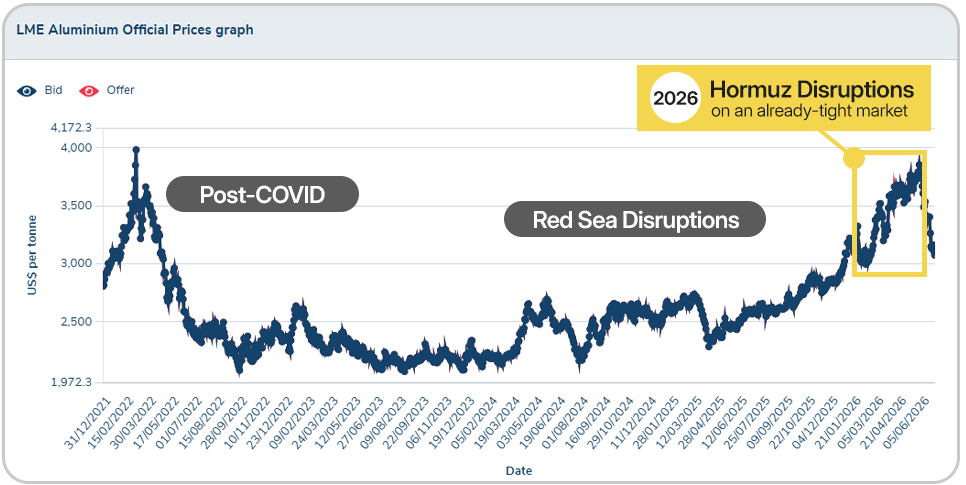
Aluminum hit a four-year high on June 2, near US$3,854 a tonne. By July 1 it was down to about US$3,073, roughly 20% in under a month. Source: London Metal Exchange.

Ocean freight rates had mostly settled through late 2025, then climbed hard once the Strait of Hormuz disruption hit, up roughly 80% since. Source: Drewry World Container Index.
What pushed the LME up (and down)
What pushed the LME up?
1) Shipping through the Strait of Hormuz got cut off. That's the export route for aluminum out of the UAE and Bahrain, about 9% of the world's supply.
2) China had a 45-million-tonne production cap since 2017 and finally hit it in 2025.
3) Stockpiles were already low before any of this happened. LME inventories dropped over 30% between February and June.
Why it came back down in a few weeks?
The LME came back down, and it's been sliding pretty steadily since the June 2 peak. It picked up speed once an interim US-Iran deal looked likely in mid-June, and dropped sharply on June 15 when that deal was actually announced, pointing toward the strait reopening. Up to 600,000 tonnes of stranded Middle East aluminum could re-enter the market once shipping normalizes.
Expected price increase
We stocked up ahead to hold pricing as long as we could. But as each format's Canadian stock runs out, the replacement lands at today's cost and the price moves with it. A few formats and lids in some warehouses have already shifted, with the next around August, as the market is still well above last year even after the June drop.
What this means for you
• Not on a contract - The new pricing applies to your can orders as each format turns over, starting around August.
• On a contract - Nothing changes until renewal, then the same applies.There's no flat percentage. It's case by case by format and warehouse (Delta, Calgary, Trenton, and Halifax), so your BDM has the real number for what you order.
We've been here before
Prices might keep moving either way, that's been true for years now and probably won't stop being true. What we can do is keep stock ready for quick dispatch, negotiate freight where we can, and share the load with you rather than pass on the full swing. It doesn't always go perfectly, we ran short on stock in 2024 despite the planning, but that's the standard we're working to.
Talk to your BDM if you want the actual number for your order. We'll do our part straight, so you can do yours with a clear head.


